
Tips from the Data Pack: Lessons from a Year of Learning Together
Over the past year, nonprofit data practitioners from across the Student Success Network tackled some of the most persistent challenges in the field: survey design, youth voice, dashboards, staff buy-in, and data culture. Our organizations, programs, and tools varied widely — but the lessons? Surprisingly similar.
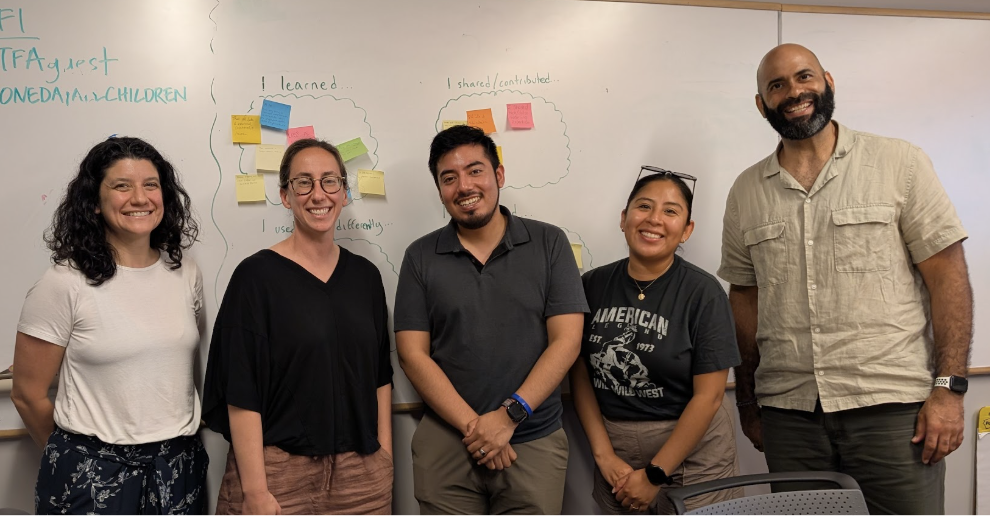
Pictured: Casey Castro, NYC Mission Society; Yaneth Sanchez, Opportunity Hub; Michele Paolella, Rocking the Boat; Ali Holstein and Robert Zarate-Morales, Student Success Network
Not Pictured: Maddie Toll, American on Tech; Michele Paollela and Andi Wiley, Children’s Aid; Jessica Elsaesser, I Have A Dream Foundation; Cindy Molina, Good Shepherd Services; Destiny Julius, Opportunity Hub; Sunaina Roa, Generation Citizen
Lesson 1: Data systems live inside human systems
A familiar challenge kicked off one of the year's biggest conversations: Despite thoughtful logic models, staff training, and solid data collection systems, data wasn't always being entered consistently.
The group's instinct wasn't to add another training or redesign a form. Instead, Pack members encouraged looking more closely at staff workflows, competing priorities, and whether data collection actually fits into the realities of program delivery. Strategies like shadowing staff, reviewing workflows together, and asking whether the data helps staff answer questions they care about surfaced as more promising starting points.
🐺 Tip from the Pack: Before redesigning a tool, spend time understanding the work surrounding it.
Lesson 2: Less is often more
Whether the topic was surveys, dashboards, competencies, or staff meetings, focus came up again and again. Members of the Pack shared examples of narrowing dashboards to a few meaningful indicators, asking fewer survey questions, focusing teachers on one or two competencies at a time, and using quick feedback loops instead of waiting for annual data collection cycles.
🐺 Tip from the Pack: If a report, survey, or dashboard feels overwhelming, try removing something before adding something.
Lesson 3: The best data conversations start with purpose
A question that resurfaced throughout the year: What are we actually trying to learn?
During a session on data discussions, Pack members explored how conversations shift when we're clear about whether data is being used for learning, improvement, decision-making, or accountability. Starting a “data meeting” with a specific purpose informs who is in the room, what data is needed, and how the conversation should be facilitated.
🐺 Tip from the Pack: Don't start with the chart. Start with the question.
Lesson 4: Youth voice is more than a survey
Members brought creative approaches to understanding young people's experiences and incorporating their perspectives into program improvement: empathy interviews, youth advisory councils, student evaluators who help design and test surveys, exit tickets after events, and bringing feedback back to participants before making major changes.
One conversation explored a challenge many organizations know well: Young people may request a program or opportunity, but participation doesn't always follow. Rather than reading this as a contradiction, Pack members encouraged digging into the barriers, incentives, relationships, or formats that might be shaping engagement.
🐺 Tip from the Pack: Feedback becomes more meaningful when participants can see how it shaped decisions.
Lesson 5: Data culture is built through relationships
One of the strongest themes from the year: Successful data practices depend as much on relationships and routines, as they do on technology. Pack members shared examples of program managers reviewing a small set of metrics during supervision, “data champions” supporting peers, staff helping design their own systems, celebrating data wins in team meetings, and creating space for collective sense-making, rather than just sharing reports.
The Pack considered how power dynamics and psychological safety shape what's actually possible in the room. Several organizations shared that their most productive conversations paired data with stories, observations, and staff expertise, rather than treating numbers as the whole story.
Two moments from the year said it best:
“Data is only successful as a tool if relationships and trust are present.”
“Data is a team effort. If you have shared goals, you're on the data team.”
🐺 Tip from the Pack: Strong data culture is built through trust, shared ownership, and ongoing conversation.
What We'll Carry Forward
At our final session, members of the Pack reflected on what the Data Pack meant to them. One described the group as "like my supervision." Another shared it helped them build the case for additional data capacity at their organization. Others left meetings with practical ideas, new confidence, and a reminder that many of the challenges they face are shared across the sector.
The most important takeaway? Good data work isn't just about collecting information. It's about creating the conditions for learning, reflection, and improvement together.
Interested in joining the Pack when we restart in September 2026? Learn more and sign up here.
This blog was written by Director of Collaborative Improvement, Ali Holstein, and edited for posting by Senior Communications Manager, Jamiee Nathaniel.